


A fresh storm is brewing over government spending after details emerged that nearly Ksh 17 billion has been set aside for State House in the 2025/2026 financial year, triggering sharp criticism from leaders and raising questions among the public.
Among those speaking out is Kiharu MP Ndindi Nyoro, who has termed the allocation excessive and out of touch with the realities facing ordinary Kenyans. With the cost of living still high and key sectors struggling, Nyoro argued that the money could be better used elsewhere.
In his remarks, he pointed to the ongoing crisis in the education sector, saying thousands of Junior Secondary School intern teachers remain in limbo despite their crucial role.
“Instead of wasting that money in political sloganeering, that money is better off funding our education sector or our health sector,” Nyoro said.
He added that the same funds could confirm up to 44,000 intern teachers into permanent and pensionable jobs, a move that would not only stabilise the workforce but also improve learning outcomes in public schools.
Quiet budget expansion
What has made the situation more contentious is how the budget grew. The allocation was initially set at Ksh 8.6 billion in June 2025 but later rose to Ksh 16.998 billion through supplementary spending allowed under Article 223 of the Constitution.
The extra Ksh 8.42 billion was released without prior parliamentary approval, going towards operational costs, maintenance, and additional state lodges. A breakdown shows that most of the funds are for recurrent expenditure, now standing at over Ksh16.1 billion, with less than Ksh 1 billion going to development.
This sharp increase has drawn scrutiny, with critics questioning both the timing and necessity of the additional spending.
The size of the allocation has also stood out globally. Kenya’s State House budget now exceeds that of the White House in the United States, estimated at Ksh 12.6 billion.
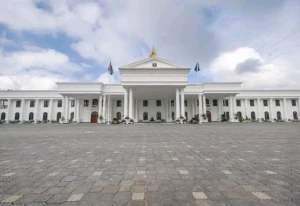
It is also significantly higher than what other African countries spend on their executive offices, including Nigeria, South Africa, and Tanzania, all of which operate on much lower budgets.
Former Attorney General Justin Muturi described the situation as difficult to defend, especially given the country’s economic position.
“It cannot be that the Kenyan government, the State House of Kenya, spends Ksh 17 billion in a single year, whereas the White House in Washington, America, which we go to beg from, spends Ksh 12.6 billion. That is embarrassing. Here we are spending so much of taxpayers’ money, yet we still have to beg while the citizens suffer,” he said.
Oversight concerns have also been raised by Margaret Nyakang’o, who warned that the current pace of spending could see the funds depleted before the financial year ends.
Data shows that about Ksh4.4 billion was already spent between December 2025 and February 2026, a trend that has sparked fears of further budget adjustments down the line.













Leave a comment