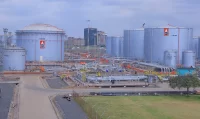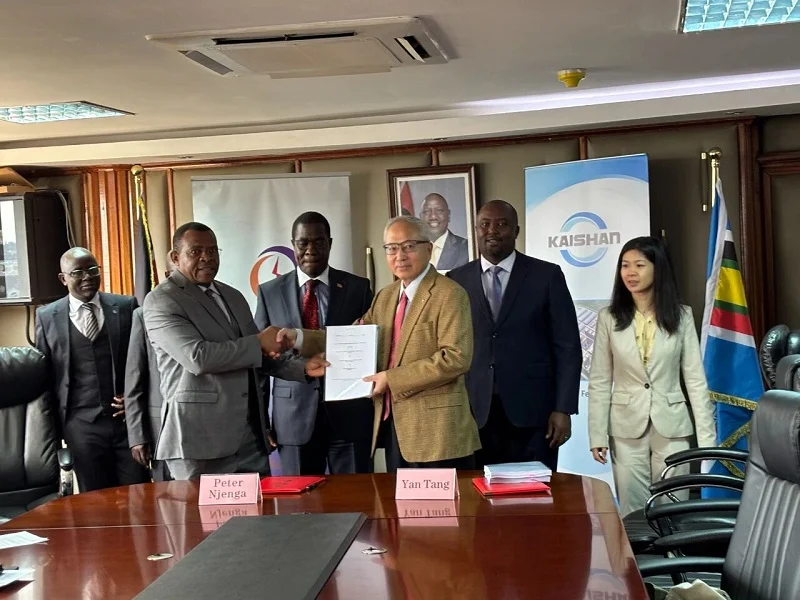
KenGen (Kenya Electricity Generating Company) and China’s Kaishan Engineering Group Limited, have launched the world’s first geothermal-powered green fertilizer manufacturing plant, estimated to cost some US$ 800 million (KSh 103.2Bn). This fertilizer complex, that uses steam from KenGen’s geothermal power plant, is billed to be Africa’s first and marks a new frontier in the clean energy and agricultural transformation space.
“This project shows that Kenya is not just a leading producer and consumer of clean energy, we are now going further to add value and generate prosperity from it,” said Kenya’s President William Ruto while officiating the project’s ground-breaking event held in Olkaria Naivasha this Monday, November 2nd 2025.
He said the fertilizer project will support growth of Agriculture and Industrialization by lowering cost of the input for local farmers.
KenGen Managing Director Eng. Peter Njenga said the project, which is riding on the listed state-owned firm’s vast geothermal power capabilities, shows Kenya’s leadership in geothermal development, already ranked among the world’s top ten producers.
The first of a kind, the use of KenGen’s geothermal steam to power the production of green ammonia and fertilizer, dramatically cuts carbon emissions and fertilizer import dependence across the Eastern Africa region.
Under the agreement, Chinese local subsidiary, Kaishan Terra Green Ammonia Limited, will construct and operate the facility using 165MW of geothermal energy supplied by KenGen over a 30-year period.
The plant is expected to produce between 200,000 and 300,000 tonnes of green fertilizer annually, making Kenya the first nation in Africa, and among only a handful worldwide, to industrialize fertilizer production entirely through renewable energy.
The project is forecast to avoid more than 600,000 tonnes of carbon dioxide emissions each year and generate more than 2,000 direct and indirect jobs.
It will also deliver an estimated US$ 13 million in annual net profits to KenGen, while stabilizing fertilizer prices for local farmers and strengthening national food security.
“Beyond local fertilizer production, the KenGen Green Fertilizer project is forecast to create over 2,000 direct and indirect jobs in construction, operations, maintenance, supply chains, and services. These are career pipelines for electricians, plant operators, process engineers, logistics managers, lab technicians, and local suppliers, “said President Ruto.
According to KenGen CEO Eng. Peter Njenga, the partnership is a milestone in clean industrialization and that geothermal power is the bridge between Africa’s green energy potential and its manufacturing future.
The KenGen project also forms part of the Africa Green Industrialization Initiative, launched at COP28 to accelerate green manufacturing across Africa.
The KenGen green fertilizer project is poised to set a precedent for other African nations seeking to couple renewable energy resources with industrial production. By converting geothermal heat, an abundant but underused resource, into a driver of agricultural self-sufficiency, Kenya may have offered a blueprint for the continent’s future green growth.
KenGen CAN Fertilizer Plant: Annual Projection and Project Specs.
The KenGen-Kaishan Group fertilizer plant project will involve construction of a 165.4MW geothermal power plant that will produce 100,000 tonnes of green ammonia and green fertilizer annually.
The project is forecast to generate between US$220-US$ 250 million in annual revenue and will utilize geothermal energy to produce green ammonia, used for manufacture of Urea and Calcium Ammonium Nitrate fertilizers( CAN), popular with local farmers for planting and top dressing crops.
The fertilizer plant is located at Olkaria Geothermal field in Naivasha with a green area of 180,000 tonnes and will produce 300,000 tonnes of CAN fertilizer, with the manufacturing plant expected to have a lifespan of more than 25 years. This project is expected to reduce Kenya’s reliance on imported fertilizer and promote sustainable agricultural practices.
Kenya spent approximately US$ 451.2 million or KSh 58.2 billion to import fertilizers in 2023, according to the United Nations COMTRADE database on international trade.. Other sources disclose that this import bill has escalated to KSh 80 billion.
The main suppliers of fertilizer to Kenya are the Soviet Union, Finland and China.
On a global scale, Energy remains a critical factor in fertilizer prices. This is because many global fertilizer producers rely on natural gas for production of nitrogen fertilizer. In the United States, natural gas prices are projected to rise into late 2025 and 2026 as liquefied natural gas export capacity grows.
This means that cost of producing ammonia, urea and UAN is higher than it was in early 2024, when gas was relatively cheap. These dynamics seep into global supply chains and will affect local fertilizer prices in Kenya.
ALSO READ: KenGen Records an End-Year Net Profit of 10.5 Bn