

In March 2007, Safaricom launched M-Pesa, the mobile money service few in Kenya imagined could unleash an economic earthquake. Within a year or so, M-Pesa had started reshaping how millions of Kenyans send, save and spend money. The success, steered by CEO Michael Joseph, transformed Kenya, a once predominantly cash-driven economy, into a global leader in mobile money innovation.
Today, M-Pesa processes transactions worth trillions of Kenyan shillings annually, plays a significant role in financial inclusion and remains a critical revenue stream for Safaricom. More importantly, it has become an everyday tool of life for millions of Kenyans.
But the question of who really invented M-Pesa remains on many a mind. This is the idea behind what is arguably Kenya’s most iconic tech success story, with the service having evolved from just money transfer, to microloan tool and eventually building into a mobile money phenomenon.
It should be understood that the concept that evolved into M-Pesa came about way before the 2007 launch by several years. According to Vodafone and Safaricom’s own historical accounts, the service began as part of a project to deliver microfinance services via mobile phones. Vodafone, which owned a 40 % stake in Safaricom, secured funding from the UK’s Department for International Development to develop the technology.
> Meet the Three Men Who Built Safaricom Into a Ferocious Mobile Giant
The early prototypes were tested in the mid-2000s with the aim of using mobile technology to allow borrowers to repay micro-loans remotely. It was during these trials — particularly in Nairobi and the neighbouring town of Thika — that something unexpected happened: users started using the system not just for loan repayments but to send money to each other.
That sideshow, which revealed that Kenyans wanted a simpler way to send money home without physically carrying cash became the guiding light for the product’s commercial rollout. “We saw an opportunity here of filling a big gap in the market,” said Pauline Vaughn, who led the Safaricom team that took M-Pesa to market.
The Name Behind the Idea: Nick Hughes
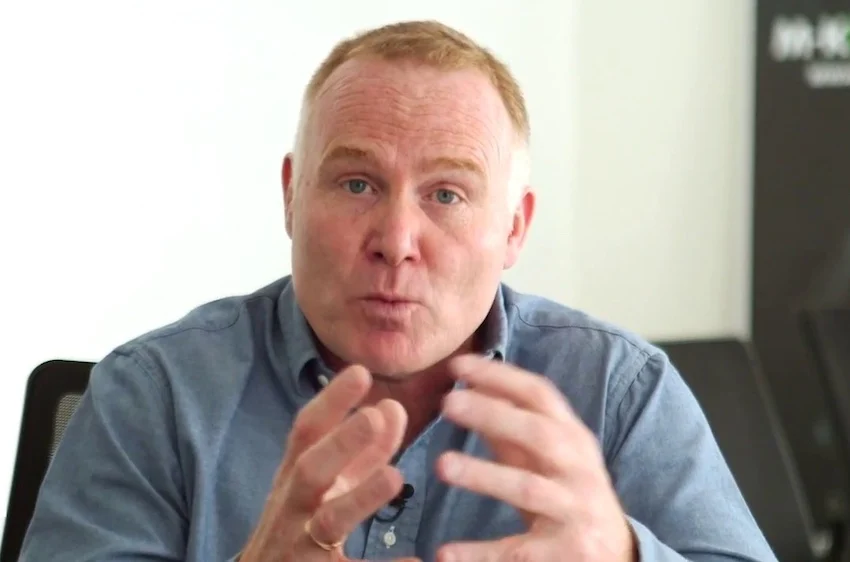
The man who is most commonly credited with inventing M-Pesa is Nick Hughes, a British technologist who, at the time, was head of social enterprise at Vodafone. Hughes pitched the concept in 2003-2004 and led the development team that turned it into a functioning prototype.
“I started and led the team that developed and launched M-Pesa,” he said. “What we provide is a very simple service which allows a customer who’s typically unbanked to load money into a digital wallet and move that money to other participants electronically.”
Some local commentators have argued that credit for the idea should lie with Kenyan innovators who were working on similar concepts around the same time.
Mr Michael Joseph, Safaricom’s founding CEO, has publicly credited Hughes with the original concept, even calling himself the “mother of M-Pesa” to acknowledge the team of people involved in shaping and commercialising it.
The British involvement in M-Pesa’s conception is significant. Vodafone provided both funding and engineering expertise, and the technology partner selected to build the system, Sagentia, was based in the UK.
Kenya’s Role: Testing Ground and Growth Engine
Although the initial idea did not originate in Kenya, the Kenyan market was crucial in transforming M-Pesa from a prototype into a mass-market success. Safaricom’s decision to re-engineer the system — changing it from a niche loan repayment tool to a general money transfer platform — was driven by early user behaviour in Nairobi and Thika.
In those first months, Safaricom invested heavily — reportedly $10 million — to adapt the service to local needs, build out the agent network, and persuade customers to trust the new platform.
Marketing also played a vital role. Early campaigns simplified the message: “Send money home.” That resonated deeply in a country where traditional remittance channels involved long bus journeys and unsafe cash transfers.
Controversies and Competing Claims
Not everyone accepts the official narrative. Some local commentators have argued that credit for the idea should lie with Kenyan innovators who were working on similar concepts around the same time, or who attempted to register intellectual property before Vodafone did.
A 2012 certificate from Kenya’s Copyright Board acknowledged a work titled Mobile Cash Transfer registered by a Nairobi resident named Nyagaka Anyona Ouko, who claims to have pitched a money-transfer concept to Safaricom in 2003. This claim has never been tested in court, and no legal challenge has shifted the widely accepted origin story of M-Pesa.
> Kenya’s Home Appliances Market Soars as Demand Grows
Even among academics, there has been debate over how to frame M-Pesa’s “invention” — whether as a British technological innovation, a Kenyan commercial triumph, or a collaborative global south success story shaped by cross-border partnerships.
From Mobile Cash to Financial Inclusion Powerhouse
Whatever its origins, M-Pesa’s impact is undeniable. What began as a tool for microfinance repayment has evolved into a full financial ecosystem that enables sending and receiving money, paying bills, accessing credit and savings products, and even facilitating international transfers.
As of the mid-2020s, millions of users across East Africa depend on M-Pesa daily, and similar services modelled on its architecture have sprung up across the continent. Its success has not only boosted Safaricom’s bottom line — accounting for a growing share of the company’s revenue — but has positioned Kenya as a leading hub for financial technology innovation.
A Shared Innovation Legacy
The story of M-Pesa’s invention highlights the complexity of innovation in a globalised world. While the original idea emerged from a British Vodafone team, its refinement, commercialization, and explosive uptake were deeply rooted in Kenyan market realities. M-Pesa today stands as both a testament to international collaboration and a powerful symbol of Kenya’s role in shaping the mobile money revolution.
Through that lens, rather than asking “Who invented M-Pesa?” perhaps the real story is how it was brought to life — through collaboration, adaptation, and the Kenyan people who adopted mobile money at an unprecedented scale.






Leave a comment