

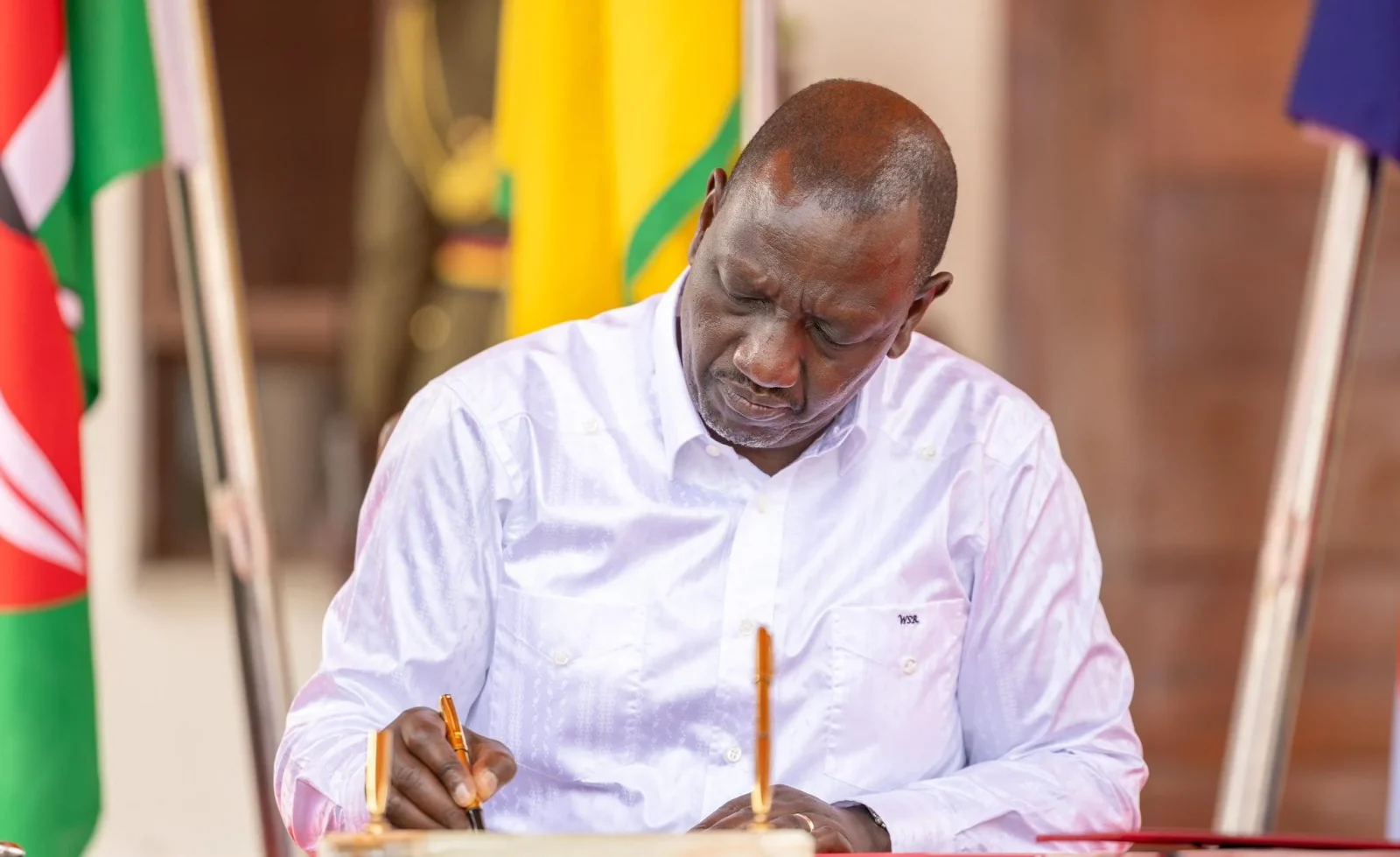
President William Ruto has stated repeatedly that his long-term mission is to steer Kenya into a new era of economic transformation, an era he envisions as the foundation of a future first-world nation.
To achieve the dream, Ruto has severally promised a multi-sector reform programme which includes modern infrastructure, a digital leap, restructured education, stronger agriculture, expanded manufacturing, revamped policing, and a deeper push into the Blue Economy.
Roads
At the heart of the first-world promise is a drive to restore and expand Kenya’s infrastructure.
When Ruto took office, Kenya’s infrastructure sector was, by the government’s own admission, “suffocating” under KSh175 billion in pending bills and more than 580 stalled road projects. Construction sites had collapsed into inactivity, and contractors had lost confidence in government.
To restart the engine, the administration began by paying arrears and pivoting to new financing models such as securitization, PPPs, and facilities like the KSh16.4 billion UBA infrastructure credit line. This move created liquidity and revived construction nationwide.
The numbers show a phased recovery with 495 km of roads completed in FY 2022/23, 542 km in FY 2023/24 and a target of 1,144 km for FY 2024/25.
The numbers show a phased recovery with 495 km of roads completed in FY 2022/23, 542 km in FY 2023/24 and a target of 1,144 km for FY 2024/25.
These include notable networks such as the Nairobi Western Bypass, Eldoret Bypass, Garsen–Witu–Lamu, and ongoing megaprojects such as Kenol–Sagana–Marua dualing, the Mau Mau Road, and county-level rural roads by KeRRA.
Beyond highways, the government is also building toward urban modernization. The Bus Rapid Transit (BRT) network in Nairobi is framed as a critical step toward reducing congestion, improving air quality, and building a more efficient capital city.
Modern markets
Perhaps the most transformative—yet least publicized—initiative is the three-tier nationwide modern market infrastructure programme.
The government argues that markets, long ignored, are central to the Bottom-Up agenda. The program includes:
a) 39 Metropolitan markets (KSh400 million each)
These function as urban commercial ecosystems with refrigeration, ICT hubs, sanitation facilities, and wholesale retail systems targeting major populations. They are designed to reduce post-harvest losses, lower food prices, and create thousands of jobs.
b) County markets (KSh150 million each)
These mid-size markets strengthen rural–urban trade, provide dignified working environments, enhance storage, and stabilize income for smallholder farmers.
c) Municipal markets – 100 town markets (KSh50 million each)
These are the heartbeat of grassroots communities. They support mama mbogas, boda boda operators, youth traders, and local retail businesses. They decentralize economic activity away from big cities and strengthen last-mile trade.
Aviation
While roads dominate public debate, Ruto’s administration is aggressively modernizing Kenya’s aviation capacity. The plan frames airstrips as new highways that connect rural economies to tourism, trade, and emergency response.
Key projects include:
Narok Airport – A gateway to Maasai Mara
For the first time, Maasai Mara could receive direct international flights. This dramatically reduces travel time for tourists, boosting local hospitality and conservation-linked enterprises.
Garissa Airstrip upgrade
Now being expanded to handle larger aircraft, positioning Garissa as a hub for livestock trade and cross-border commerce with Somalia and Ethiopia.
Ukunda passenger terminal (Diani)
A new terminal to support surging tourism at Diani—one of the world’s most rated beaches.
Bomet, Suneka, Lichota, and Turkana airstrips
These aim to drive horticulture exports, open up Southern Nyanza to national transport, expand agribusiness, and strengthen local tourism circuits.
Together with the $1.63 billion JKIA modernization, Kenya is positioning itself as a regional aviation hub.
Blue economy
Kenya’s fishing communities, often marginalized, are now at the heart of a massive modernization push. Billions have been invested in modern landing sites, fresh fish markets, cold rooms and ice plants, processing facilities, improved docks and value-addition equipment.
The impact is visible from Homa Bay to Kwale, Busia to Siaya, and Lake Turkana.
Notably Shimoni Fish Port (KSh2.6 billion) is emerging as the coastal anchor for exports, cold-chain logistics, and marine tourism while Koginga Modern Fish Market (KSh345 million) now serves over 2,000 fishmongers daily.
The goal is ambitious: expand the Blue Economy’s contribution from KSh30–40 billion to KSh300–500 billion annually.
Education reforms
Ruto’s education transformation is entails;
a) Policy and curriculum reform
The 2024 National Education Policy shifts Kenya’s education system to skills, values, innovation, STEM (Science, Technology, Engineering, and Mathematics), climate literacy and digital learning.
The full shift from 8-4-4 to 2-6-3-3-3 formalizes Kenya’s commitment to Competency-Based Education and Training (CBET).
b) Massive budget allocation
Education receives the largest government allocation: KSh703 billion in the 2025/26 budget (up from KSh540b in 2022).
c) Higher education funding model
A student-centered model ensures scholarships and loans reflect financial need, vulnerable students are prioritized and no one is denied university access due to poverty.
d) Teacher reforms
The reforms so far entail 76,000 new teachers hired in two years, mandatory 1-year internship for new teachers, introduction of a teacher training framework, improved welfare through faster CBA reviews, medical cover upgrades and a proposed “first out of college, first in” hiring policy.
These reforms aim at reducing class sizes, cutting attrition, and modernizing teaching.
Digital opportunities
Key pillars include:
100,000 km of fibre optic cable
This promises nationwide high-speed connectivity—from Turkana to Kwale—enabling virtual education, telemedicine, rural e-commerce and digital freelancing.
ICT hubs in TVETs & counties
These hubs train youth in coding, cybersecurity, digital marketing, virtual assistance and content creation.
The ICT Authority targets 20 million citizens for digital skills training.
Ajira Digital & Kenya Start-up Act
The ecosystem aims to convert skills into income, enabling youth in Kisumu, Kakamega, or Kapsabet to work for global clients remotely.
International tech firms (e.g., AWS)
Their entry into Kenya signals investor confidence in Kenya’s rising innovation capacity.
Manufacturing & Trade
The sector grew 5.1% in 2024, driven by EPZ expansion, textile factories, assembly plants, industrial parks such as Kinyaga and energy cost reductions.
Manufacturing output has grown 55% from 2020 to 2024, from KSh2.38 trillion to KSh3.69 trillion.
Jobs are rising in processing, textiles, digital manufacturing, and agro-industries.
Trade agreements
Kenya has secured new bilateral deals with UAE (CEPA) (boosting horticulture, livestock, and flower exports), China (expanding SGR routes and major highways), Uganda (linking Naivasha–Malaba SGR and border roads) and EU (duty-free, quota-free access for Kenyan goods).
These agreements promise to lower transport costs, increase exports, and inject cash into households.
Agriculture
Agriculture remains the anchor of rural livelihoods. The reforms span the entire value chain including expanded fertilizers and input subsidies, modern storage and warehouses, rehabilitation of rural roads, cooperative strengthening, modern markets for farmers and revival of tea, coffee, and sugar sectors.
Kenya has had its first hunger-free season in many years, due to increased harvests and food system resilience.
Coffee, tea, and sugar farmers are earning the highest returns since the 1980s.
Youth are moving into modern farming—poultry, horticulture, value addition, and digital agriculture.
Police recruitment & security modernization
The government frames the ongoing mass police recruitment as both a security and socio-economic policy tool.
Kenya currently has 1 officer per 500 citizens, far below global standards. Recruiting thousands more officers aims to enhance patrols, emergency response, election preparedness and community policing.
The process includes same-day results to eliminate corruption loopholes, strict integrity measures and equal opportunity across counties.
For youth, this represents stable employment, skills, and upward mobility.
Path to a first-world future?
The scale of activity—roads, markets, aviation, digital networks, industrial parks, fisheries, education reform—is extensive. The government is not just fixing broken systems; it is attempting to shift Kenya’s economic foundation altogether.
Whether Kenya becomes a first-world country will depend on consistency of implementation on reforms, political stability, fiscal discipline, public trust and sustainability of reforms.
But based on the available evidence, Ruto’s administration is engineering one of the most ambitious development overhauls in Kenya’s history.
If the momentum holds, the country could experience a structural transformation whose effects will be felt for generations.
Read: Ruto Unveils Diaspora Bond for Kenyans Abroad
>>> Ruto: Kenya’s Economy Now Among Africa’s Top 6






In recent times, technology has proven to be more sophisticated and just like any other currency that can be stolen or lost, crypto and other digital assets has proven to be more difficult to recover but not impossible, and just like searching for any other monetary currency, you need a trustworthy and honest agency or personnel who can track and recover the value lost or stolen, in my case I hired recoveryhacker101@gmailcom, they followed the blockchain and was able to recover over 247kof my stolen funds within a couple of weeks. The fees for the services I received was fair and communication was excellent