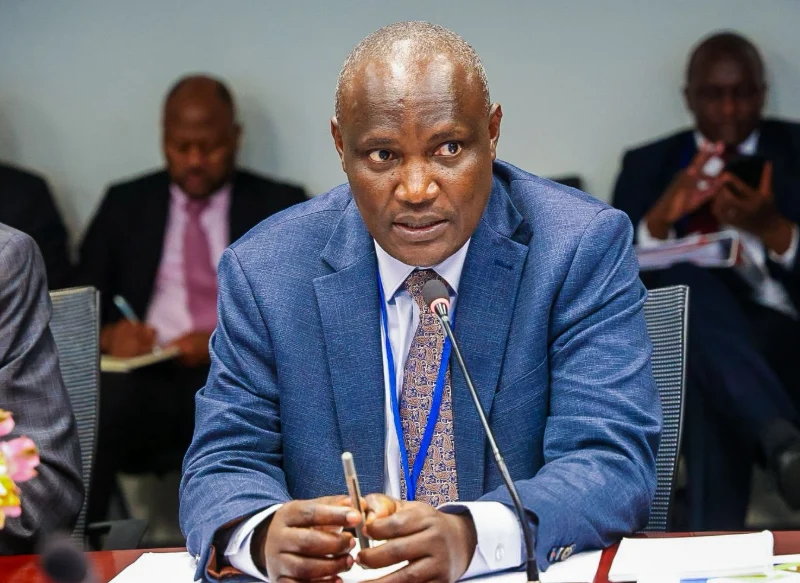
Kenya is stepping up its global economic diplomacy, with Treasury Cabinet Secretary John Mbadi leading a powerful team to the World Bank headquarters in Washington, D.C., for key talks aimed at securing confidence in the country’s economic reforms.
The meeting took place on the sidelines of the IMF and World Bank Annual Meetings and signals Kenya’s growing determination to show the world that its economy is on the right track.
Mbadi met with the World Bank’s Regional Vice President for Eastern and Southern Africa, where he presented what the Treasury described as a strong case for Kenya’s resilience and fiscal discipline.
According to a statement shared on the National Treasury’s official X account on Tuesday, October 14, 2025, the discussions focused on how Kenya’s economic performance is holding up despite global challenges.
“Mbadi highlighted Kenya’s resilient macroeconomic fundamentals, with stable inflation, moderate interest rates, a stable exchange rate, and external reserves sufficient to cover over five months of imports,” the statement read in part.
Treasury officials say the country’s recent efforts to restructure and manage debt have already paid off, boosting investor confidence.
“Recent Liability Management Operations were noted as instrumental in enhancing debt sustainability and reinforcing investor confidence,” the statement reads.
Mbadi was joined by a high-powered team including Treasury Principal Secretary Chris Kiptoo, Central Bank Governor Kamau Thugge, Public Debt Management Office Director General Raphael Owino, and PPP Directorate boss Kefa Seda.
Their presence underscored the weight of Kenya’s economic agenda as the country works to steady its finances and attract new investment.
The delegation also reviewed progress under the Development Policy Operation a key reform program supported by the World Bank. It focuses on improving how the government manages money, handles procurement, and controls the wage bill.
“Progress under Development Policy Operation was reviewed, including the implementation of e-procurement (e-GP), Treasury Single Account (TSA), wage bill management, efficiency reforms among State-Owned Enterprises, and the finalisation of Conflict of Interest and Social Protection regulations; reflecting a commitment to transparency, fiscal discipline, and efficiency in public finance management,” the statement reads.
Beyond fiscal matters, the talks explored how the private sector can play a bigger role in driving growth through Public-Private Partnerships (PPPs).
Mbadi’s team made the case for more private capital in infrastructure, digitalisation, agro-processing, value addition, and affordable housing, all key pillars of the government’s Bottom-Up Economic Transformation Agenda (BETA).
“Kenya’s engagement with the World Bank Group exemplifies a proactive approach to macro-fiscal management, debt sustainability, and private sector-led growth,” the Treasury said.