


The push to make cross-border digital payments easier in East Africa has gained momentum after Kenya and Rwanda agreed on a new framework to support payment service providers operating in both markets.
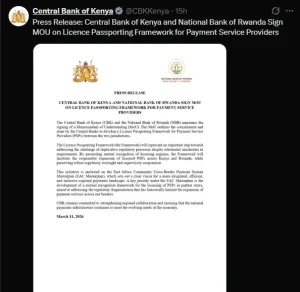
The Central Bank of Kenya (CBK) and the National Bank of Rwanda (NBR) have signed a Memorandum of Understanding that will guide the creation of a Licence Passporting Framework for Payment Service Providers (PSPs).
In a statement released in March, CBK said the agreement marks a key step toward removing regulatory barriers that have made it difficult for payment firms to expand across borders.
“The Central Bank of Kenya (CBK) and the National Bank of Rwanda (NBR) announce the signing of a Memorandum of Understanding (MoU). The MoU outlines the commitment of the two Central Banks to develop a Licence Passporting Framework for Payment Service Providers (PSPs) between the two jurisdictions,” the statement said.
Once implemented, the framework will allow payment companies licensed in Kenya to operate in Rwanda without going through a full licensing process again. The same will apply to firms licensed in Rwanda that want to enter the Kenyan market.
Payment service providers include fintech companies, mobile money operators and other firms that offer digital financial services. Regulators say these companies often face similar licensing requirements in different countries but are still forced to repeat the same approval procedures when entering new markets.
According to CBK, the new arrangement seeks to address this challenge.
“The Licence Passporting Framework will represent an important step towards addressing the challenge of duplicative regulatory processes despite substantial similarities in requirements,” the regulator said.
Even with the simplified licensing process, companies will not operate without oversight. Both regulators will continue supervising firms operating in their markets to ensure compliance with financial regulations.
“By promoting mutual recognition of licensing regimes, the Framework will facilitate the responsible expansion of licensed PSPs across the two jurisdictions, while preserving robust regulatory oversight and supervisory cooperation,” CBK added.
The agreement also forms part of wider efforts to improve payment systems across the region. CBK said the initiative supports the goals of the East African Community (EAC) Cross-Border Payment System Masterplan.
“This initiative is anchored in the East Africa Community Cross-Border Payment System Masterplan, which sets out a clear vision for a more integrated, efficient, and inclusive regional payments landscape,” the bank said.
The master plan aims to create a more connected payments ecosystem in East Africa by making it easier for people and businesses to send and receive money across borders.
Kenya and Rwanda are considered leaders in digital payments within the region. Kenya has one of the most developed mobile money ecosystems in Africa, while Rwanda has invested heavily in fintech development and digital financial services.
Officials believe reducing regulatory duplication will encourage more innovation in the sector, support cross-border trade and make digital transactions between the two countries faster and more efficient.
The new framework could also benefit consumers and businesses by improving remittance flows and expanding access to financial services across both markets.
CBK said the move reflects its broader efforts to strengthen cooperation with regional partners while improving financial infrastructure.
“CBK is committed to strengthening regional collaboration and ensuring that the national payments infrastructure continues to meet the evolving needs of the economy,” the regulator said.
If successfully implemented, the licence passporting framework could also provide a blueprint for similar arrangements among other East African countries as the region moves toward deeper financial integration.










Leave a comment