

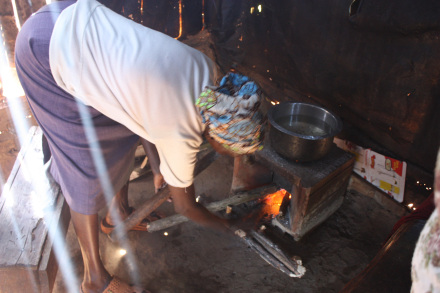
Fifteen thousand Kenyans die every year from air pollution while at least 40% of childhood deaths are caused by respiratory illnesses because of over-reliance on traditional sources of fuel.
A report by the World Bank reveals that 84% of Kenya’s population cooks using solid fuels including wood, charcoal or agricultural residue while 5% cook using kerosene.
Emissions from these fuels affect the health of millions of Kenyans while causing environmental and social damage.
The report also states that between 1990 and 2005, Kenya lost 5% of its forest cover as most of Kenyan households depended on wood for fuel leading to wanton de-forestation.
Consequently, the government is planning to reduce the cost of Liquefied Petroleum Gas (LPG) to make it affordable for low income earners in a bid to reduce the number of these deaths.
The report carried out by World Bank energy researcher Inge Van Den Berg reveals that as of 2013, Kenyans opted for other fuels since the cost of one year of cooking with LPG is Ksh35, 000 when compared to kerosene Ksh20, 000 and coal Ksh15, 000.
In its Vision 2030 Second Medium-Term Plan, the government plans to have 42% of Kenya’s population use clean fuels. The plan is to have Kenya’s population use LPG 35%, biofuels 5% and electricity 2%.
“The government converted the 35 percent goal into a bench- marked per capita consumption target of 15 kilograms of LPG per year by 2030 a sharp expansion from a baseline of just 2 kilograms in 2013,” reads the report.
Africa’s average consumption of LPG is 3 kilograms per capita per year meaning that the government has surged ahead of a number of African countries in its bid to cut down on traditional fuels.
The report further states that South Africa, whose economy is roughly the size of Kenya’s, consumes much more LPG; about 6 kilos per capita per year as of 2015, while Senegal and Ghana whose economies are smaller than Kenya’s consume between 5 and 10 kilos per capita per year.
What is worrying is that only 10% of Kenya’s top earners use LPG compared to 45–85 percent in comparable African countries.
These revelations come after a report conducted by the International Energy Agency (IEA) and World Health Organisation (WHO) released on June 4, 2018 listed Kenya as the least toxic country in the world.
Air pollution, energy consumption and renewable energy production were the factors considered by the organisations while authoring their report.
The IEA and WHO report was however termed “inconclusive” by fact checking agency Pesacheck which faulted the research’s sampling methodology.














10 Comments