

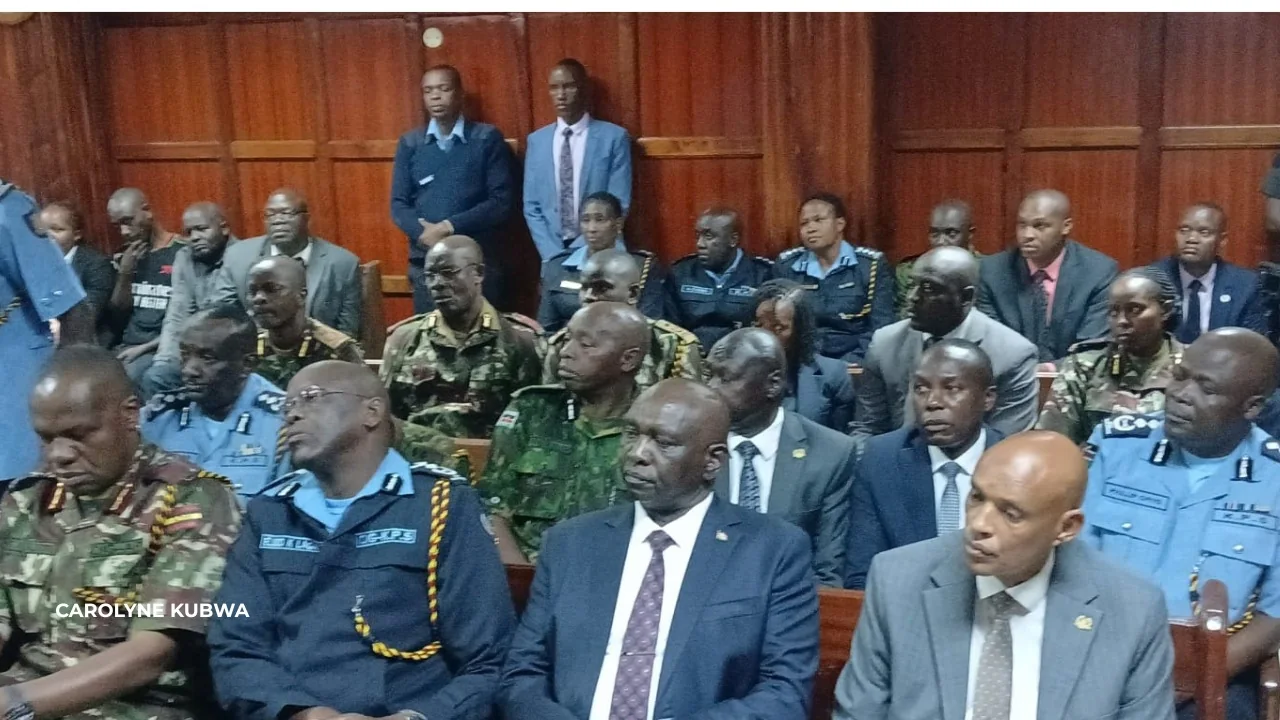
Kenya’s top police commander appeared before the High Court in Nairobi on Monday for mitigation and sentencing after a judge found him in contempt of court over roadblocks erected during protests in June.
Inspector General of Police Douglas Kanja Kirocho arrived at the court accompanied by senior officers, including Kenya Police Service Deputy Inspector General Eliud Lagat and Directorate of Criminal Investigations Director Mohamed Amin.
Kanja’s appearance followed a September 17 ruling by Justice Patricia Nyaundi, who held him personally responsible for failing to ensure that officers under his command complied with a court order governing the use of roadblocks and barricades.
The case was brought by rights organisation Katiba Institute over police restrictions imposed in Nairobi during the June 25, 2026, commemoration of the Gen Z-led protests against the Finance Bill.
Katiba Institute challenged the erection of barricades and roadblocks on major routes leading into Nairobi’s central business district, arguing that police had failed to issue the advance public notice required under an existing court order.
Justice Nyaundi found that police had erected emergency roadblocks without providing members of the public with the required timely advisory.
The dispute dates to conservatory orders issued by Justice Lawrence Mugambi on July 9, 2025, following a petition by Katiba Institute concerning police restrictions during demonstrations.
The order did not prohibit police from establishing roadblocks or security checkpoints. Instead, it required the Inspector General and officers under his command to provide timely public advisories before roads were barricaded in response to emergencies, giving residents an opportunity to adjust their plans.
The order was issued after police restrictions were imposed on roads leading into Nairobi’s CBD during protests in 2025.
The High Court later examined whether the National Police Service had complied with those requirements during the June 25, 2026, commemorations.
In her September ruling, Justice Nyaundi rejected the argument that the barricades were spontaneous measures taken in response to an unfolding security threat and therefore did not require prior notice.
The court found that police were aware in advance of the planned demonstrations and had not issued the required advisory before blocking the roads.
Justice Nyaundi consequently determined that the legal threshold for contempt had been met and ordered Kanja to appear personally before the court for mitigation and sentencing.
The finding placed responsibility on the Inspector General to ensure that officers under his command complied with the binding court order.
Kanja had denied deliberately disobeying the directive. Police lawyers argued that the contempt application was misconceived and that there was no evidence that Kanja personally authorised the individual roadblocks.
The police also maintained that the June 25 demonstrations were unlawful and that officers were acting within their mandate to prevent disorder and protect public safety.
The court nevertheless concluded that the failure to issue the required public advisory constituted non-compliance with its order.
Monday’s proceedings therefore focused on the next phase of the case: Kanja’s mitigation before the court determines the sentence arising from the contempt finding.

![IEBC Chairperson Erastus Ethekon. [Photo/Courtesy]](https://businesstoday.co.ke/wp-content/uploads/2025/06/Ethekon-150x150.webp)












Leave a comment