

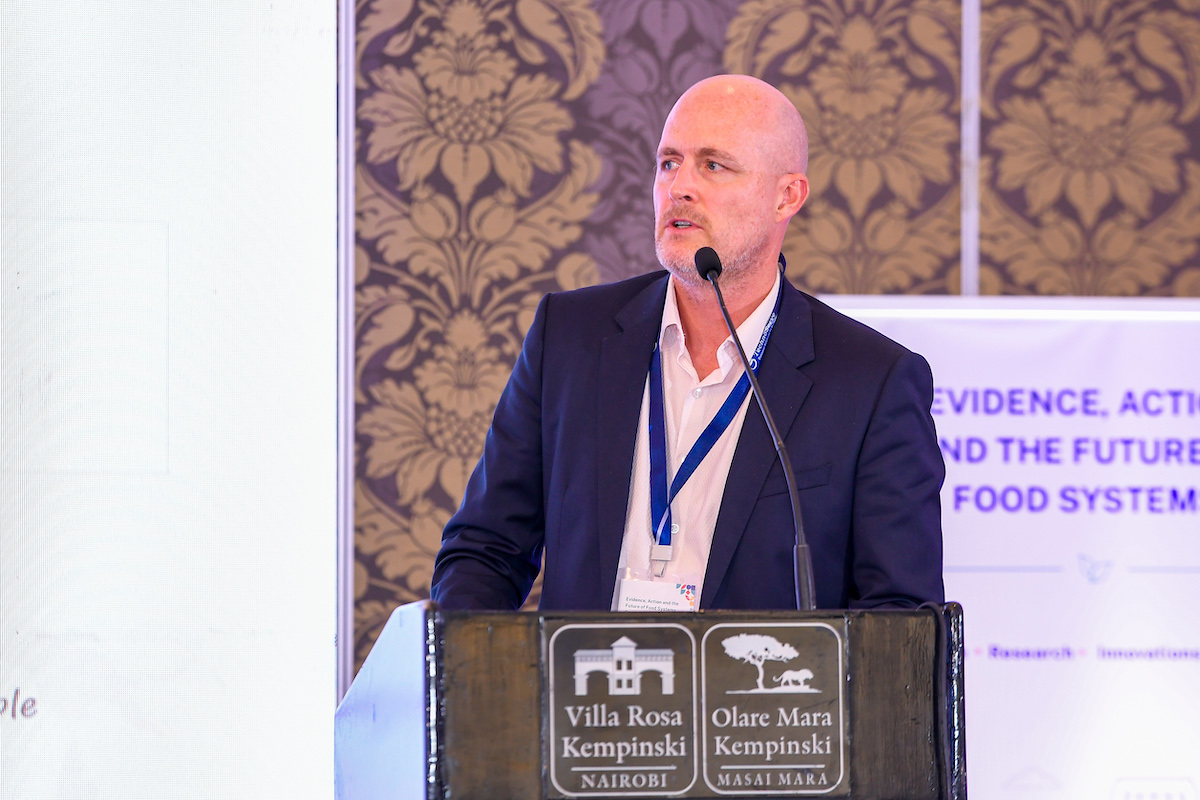
TechnoServe on 8th Sept. convened researchers, donors, private-sector leaders and other food-system actors in Nairobi for the Waste Less, Nourish More: Evidence, Action, and the Future of Food Systems Convening, bringing together three years of research and implementation learning from the NutriSave programme.
Funded by the Gates Foundation and the UK’s Foreign, Commonwealth & Development Office (FCDO) and implemented by TechnoServe, NutriSave has explored how market-based approaches can simultaneously reduce food loss and waste and improve access to affordable, nutritious fruits and vegetables for low-income communities in Kenya. “Informal food vendors were central to achieving NutriSave’s dual objectives: reducing food loss and waste while improving access to nutritious food for low-income consumers. We need to invest more in their agency if we are to achieve meaningful food system transformation in Kenya,” said Sebastian Oggema, Acting Country Director, TechnoServe.
Kenya faces a significant food-system paradox: nutritious fruits and vegetables are lost along supply chains even as many households struggle to consume enough of them. NutriSave has sought to understand where losses occur, what drives them, who is best positioned to address them, and whether commercially viable solutions can redirect more nutritious food to consumers.
New research from NutriSave and the International Food Policy Research Institute (IFPRI) is helping sharpen that picture. By tracing tomatoes, mangoes and dark leafy vegetables through Nairobi’s wholesale markets, following produce both backward to suppliers and forward to informal retailers, the research provides evidence on where losses occur and which market actors represent the greatest opportunity for intervention.
In contrast to the commonly held belief, NutriSave’s research indicated that losses were most frequently associated with storage during market hours or overnight, rather than transportation. Furthermore, the research showed that losses are concentrated among larger vendors, who handle greater volumes and are more likely to have unsold produce at the end of the day. The findings suggest that the challenge is not simply how much food is produced, but how supply and demand are coordinated across the market.
These insights point to opportunities to connect surplus produce with businesses and organisations that can use it for processing, while also exploring solutions such as cold storage where the economics support investment. Importantly, the research underscores the need for better data and cost-benefit analysis to determine which interventions can work commercially at scale. “Reducing food loss and waste is one of the clearest indicators that a food system is truly regenerative,” said Richard Pluke, Director of Regenerative Agriculture, TechnoServe. The convening also showcased NutriSave’s experience testing market-based solutions.
The programme worked with Six Square Limited to redirect surplus and cosmetically imperfect produce into minimally processed ready to cook products. NutriSave also partnered with the Baba Mboga app, a grocery delivery platform in Kenya that provides fresh produce and prepped vegetables, directly to consumers and informal vendors. Across its research and pilots, NutriSave has found that reducing food loss requires understanding the incentives and constraints of different market actors, designing solutions around consumer and business needs, testing commercial viability, and strengthening the market relationships that allow solutions to extend beyond a pilot.
The programme has captured these lessons in Waste Less, Nourish More: A Practitioners’ Playbook for Reducing Food Loss and Waste while Increasing Access to Nutrition, which offers practical recommendations for policymakers and practitioners working at the intersection of agri-food systems, nutrition and markets.
The convening featured research presentations from NutriSave partners including the International Food Policy Research Institute (IFPRI), Jomo Kenyatta University of Agriculture and Technology (JKUAT) and EDI Global, alongside discussions with market-system actors on understanding food loss and testing commercially viable, scalable food-system solutions. By integrating practical learnings from the NutriSave program, the event drove the development of scalable solutions designed to reliably address food loss and waste while improving nutrition for underserved communities.
As NutriSave moves through its close-out phase, its evidence and implementation learning are intended to inform future market-system strategies, research and investment, while contributing to Kenya’s wider efforts to reduce food loss and waste and improve food and nutrition security. The convening forms part of NutriSave’s broader effort to translate research and implementation learning into practical resources for policymakers, practitioners and market actors. The programme’s Learning Series has also shared emerging evidence and lessons through webinars, learning briefs, case studies and technical discussions.

![The expressway is a 27-kilometre toll road running from the Jomo Kenyatta International Airport (JKIA) to Westlands, Nairobi. [Photo/ NMG]](https://businesstoday.co.ke/wp-content/uploads/2022/05/images-67-150x150.jpeg)














Leave a comment