

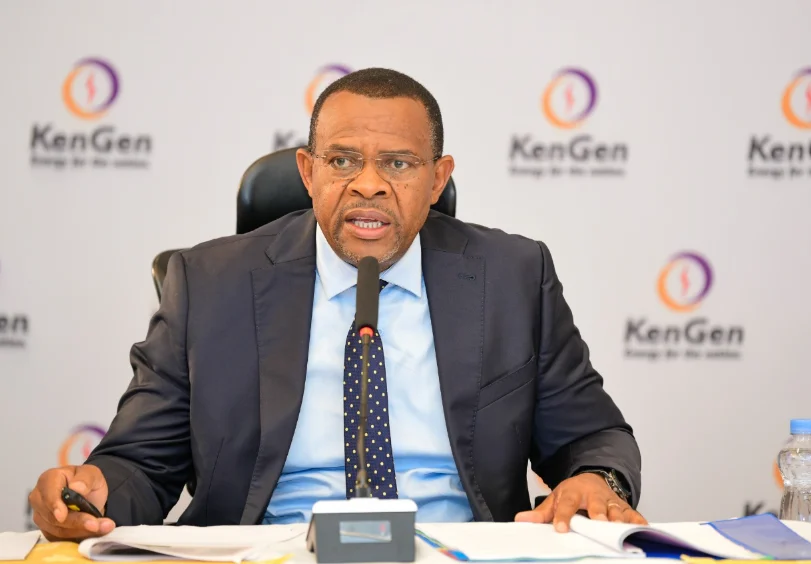
KenGen (Kenya Electricity Generating Company) Plc reported a net profit of KSh 10.35 billion for the financial year ended 30th June 2026, a 1.2% drop from KSh 10.3 billion in 2025.
The listed power generator also saw its balance sheet shrink slightly to KSh500.1 billion, a 1.1% decline from KSh 505.6 billion in 2025.
Finance income declined by 30.4% to KSh 2.9 billion, from KSh 4.1 billion, mainly because cash resources were
deployed into strategic capital investment. Purchases of property, plant and equipment increased by 14.3% to KSh 15.5 billion, demonstrating continued execution of the Company’s growth and asset-reliability agenda.
Against this backdrop, KenGen supplied 8,975 GWh of electricity to the national grid, representing 57.2% of national electricity demand. More than 90% of the electricity dispatched by the Company was generated from renewable
sources, underscoring KenGen’s position as the backbone of Kenya’s clean energy system.
KenGen has lowered its final dividend to KSh0.75 per share in 2026 from KSh 0.90 in 2025.This is subject to approval from shareholders at the next Annual General Meeting(AGM) scheduled for October 29th 2026. This dividend will be paid on or about 21st January 2027.
Looking beyond KenGen Numbers:
While investors at the Nairobi Securities Exchange(NSE) panicked upon release of KenGen end-year numbers, leading to volatile trading that saw a volume of 3,661,270 shares changing hands at a slight drop in its share prices, savvy investors are taking advantage to accumulate.
“KenGen is in a capex and capacity-expansion cycle and so its FY2026 numbers should be read in the context of where the business is in its investment cycle, rather than simply looking at whether Profit After Tax went up or down,” said CFA Dedan Maina.
He added that while the headline is that net earnings declined 1.2% to KSh10.35 billion and EPS fell 1.3% to KSh1.57, at first glance, that may look disappointing. But PAT is not the key metric to focus on at this stage.
KenGen is currently in a relatively heavy capital-expenditure phase. The company is spending to rehabilitate, expand and develop generation capacity.
The reopening of Kenya’s PPA environment in late 2025 was an important development after the moratorium had constrained new power projects and investment.
Parliament lifted the moratorium in November 2025, opening the way for new generation agreements, while KenGen’s project pipeline includes initiatives such as Olkaria I rehabilitation, Masinga, Seven Forks Solar, Gogo redevelopment and Marsabit Wind.
That changes how financial statements of KenGen should be interpreted.
KenGen is deploying huge cash to expand its generation capacity
KenGen is spending first to build capacity and commission its assets. Then, the additional capacity will start contributing to revenue and cash flows.
KenGen is therefore currently carrying some of the cost of tomorrow’s growth before all the benefits have fully appeared in today’s profit.
So what should we watch?
Revenue for the business is growing. Revenue increased 6.4% to KSh59.71 billion, while revenue less reimbursable expenses increased 6.6% to KSh49.51 billion.
That’s important.
What should be on the watch-list is whether KenGen’s underlying operating business continues to generate higher revenue as electricity production and demand increase. KenGen generated KSh29.87 billion from operations, up 7.1% from KSh27.89 billion. Because profits are accounting numbers; cash is what ultimately funds the business. KenGen can report a slightly lower PAT while simultaneously generating more cash from its core operations.
And that is exactly what we are seeing here.
- PAT ↓ 1.2%
- Revenue ↑ 6.4%
- Cash generated from operations ↑ 7.1%
That tells a much more nuanced story.
KenGen’s H1 FY2026 results had already shown the same broader direction, with operating cash flow strengthening significantly despite elevated investment spending. The price of expansion is visible in the numbers.
Capital expenditure increased 14.3% to KSh15.54 billion. This is exactly what we expect from a company investing in additional productive capacity.
Operating cash flow was KSh30.03 billion, while capex consumed KSh15.54 billion. So there is still substantial internally generated cash supporting the investment programme. At the same time, cash and equivalents declined from KSh30.12B to KSh26.66B. That’s not necessarily a red flag by itself.
Cash is being deployed.
The important question is whether today’s capex eventually produces higher revenue, stronger operating cash flows and better returns on capital.
KenGen End-Year Financial Highlights
- Profit after tax fell from KSh10.48billion to KSh10.35billion.
- EPS went from KSh1.59 to KSh1.57.
- The dividend also declined from KSh0.90 to KSh0.75.
These numbers deserve monitoring.
Operating profit actually increased 4.1% to KSh14.17billion. That means the core operating business remains profitable and growing, even though factors below operating profit resulted in slightly lower PAT.
The bigger question is:
Is KenGen converting its current investment cycle into additional productive capacity and, eventually, higher revenue and cash generation? That is the question that should be answered over the next 2 to 4 years. Not a 1.2% movement in annual net profit.
ALSO READ: KenGen Targets 5,500MW Energy Pipeline by 2034











Leave a comment