

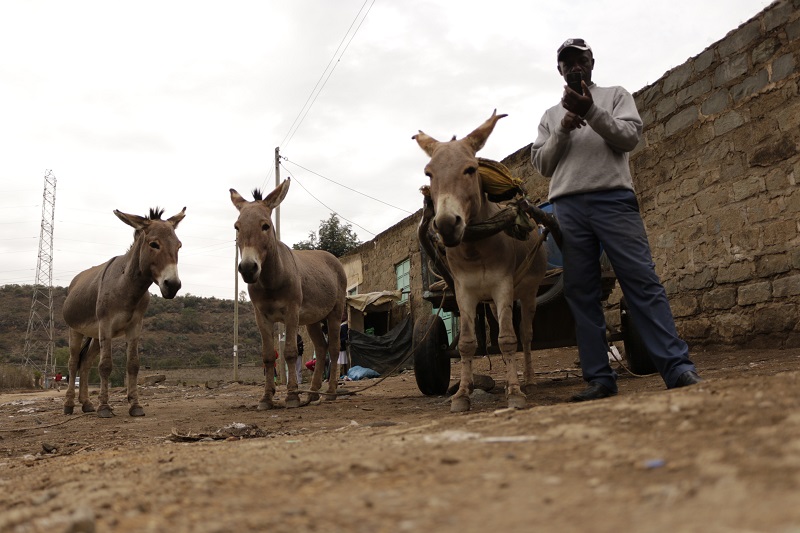
[dropcap]P[/dropcap]eople are abandoning donkey-driven businesses due to increasing theft of the animals in Naivasha, putting livelihoods on the line. They would rather earn less by engaging in other, less lucrative ventures than incur constant losses from losing donkeys.
This development is attributed to the growing demand for the animal’s skin and meat from abattoirs in the area, which are subsequently exported to China. Household economies are now suffering, given that the animal is key to generating income among residents.
Anderson Kamau, is one such individual. The 22-year old moved from Engineer area of Kinangop after clearing school in 2014, to live with his brother in Naivasha, whom he joined in the water vending business. “We were using my brother’s donkeys at the time,” he recalls, “but I wanted to go on my own, so I managed to put aside some money for this.”
Kamau saved Ksh35,000 which he used to purchase two donkeys, a hand cart and two, 250-litre drums, to ferry the water with to clients in 2015. He explains that the water vending business enabled him to purchase a 50m by 100m plot of land in 2017 in Naivasha.
However, his donkeys were stolen and he had to find something else to do. He is now a barber, a business that is not generating as much income as vending water. “It is very difficult to make money as a barber compared to what I used to do,” says Kamau.
RELATED: DONKEY MEAT HEALS A NUMBER OF DISEASES
He attends to 10 clients on average per day, each paying Ksh70. He has to pay half of whatever he makes to the barber shop owner. On the other hand, all of the Ksh700 he used to make on any given day selling water belonged to him.
Jefferson Kamau, a father of five has a similar story. His two donkeys were stolen in 2012 and slaughtered after serving him for more than five years, including helping educate his children. “One of the reasons donkeys continue to be stolen is because law enforcers don’t take the animal’s security seriously,” he says.
Kamau recalls the period between 2014-2016 when the situation reached epidemic proportions, so much that owners sought spiritual intervention by holding fasting and prayer intercessions . He is now considering selling hay.
Donkey population in Kenya remains unknown given the rate at which they are being slaughtered, even though it was estimated at 1.9 million in 2009, according to Samuel Theuri, the Innovation and Advocacy Coordinator at Brooke East Africa, an animal welfare charity organization.
SEE ALSO: COUNTY THAT HAS A POLICY TO MANAGE DONKEYS
He estimates that 100,000 donkeys were slaughtered last year and that 700 are being slaughtered everyday in the country, “yet the reproduction rate of these animals is only 100 a day,” he explains.
Donkey skins are used to manufacture anti-aging and libido enhancing agents in China. The skin fetches Ksh12,000 in Kenya and up to Ksh47,000 in China. A number of countries in Africa have banned the trade, including Niger, Burkina Faso, Mali, Senegal, Gambia and Zimbabwe. And close to home, Tanzania, Ethiopia and Uganda have done the same.
Since the trade is illegal in neighbouring countries, this means that the trade is thriving on the black market, with donkeys finding their way from south Ethiopia to Turkana and Mogotio.
NEXT: THESE GUYS LITERALLY SQUEEZE CASH FROM FRUITS









4 Comments