

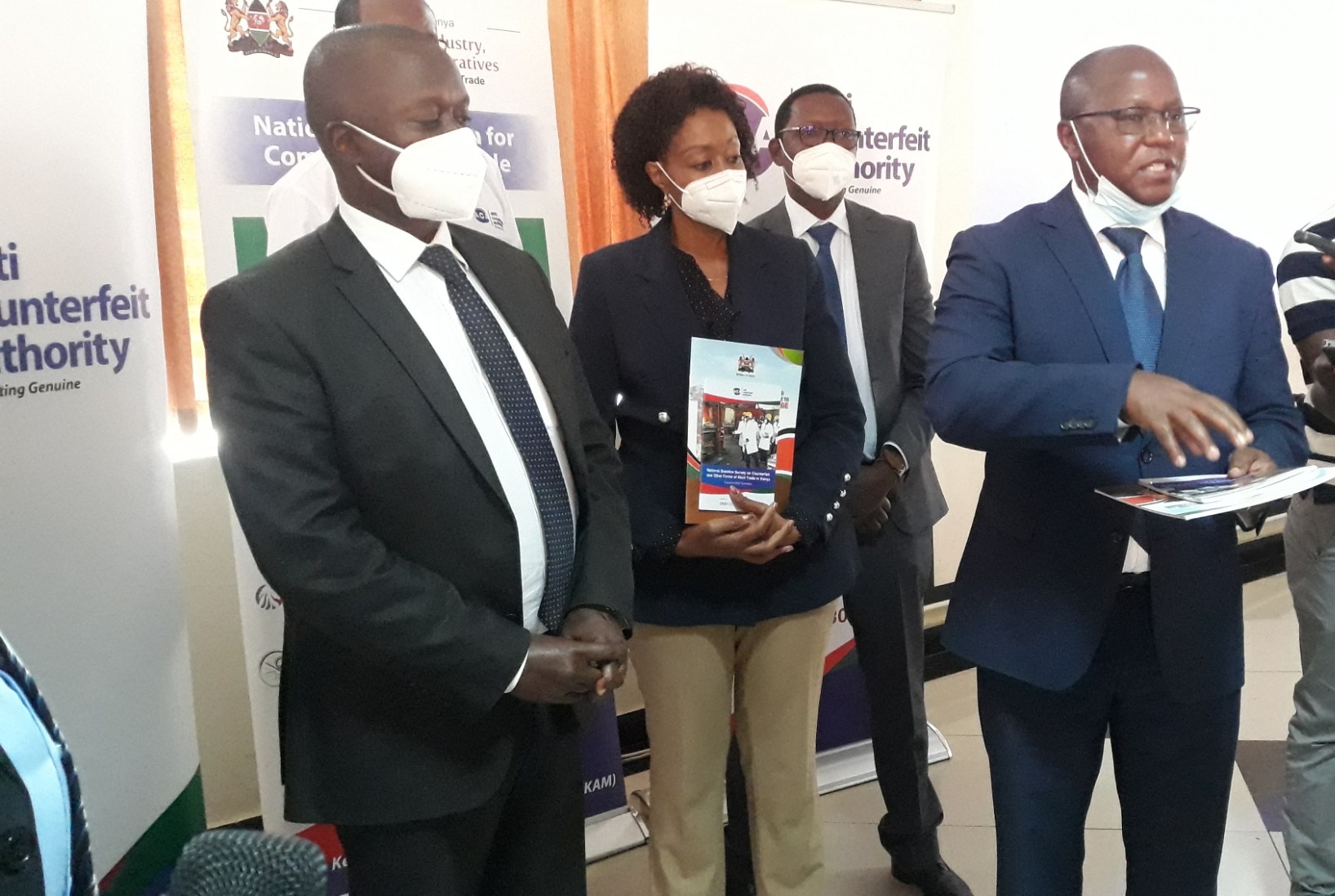
Illicit trade and counterfeiting cost Kenya a total of Ksh153 billion in the year 2018 accounting for 96% of the total government revenue loss.
According to the National Baseline Survey on Counterfeit and other forms of illicit trade in Kenya, the 2018 loss rose by 18% compared to the Ksh129 billion of revenue lost through the vice in 2017.
The report released on Tuesday in Nakuru states that the revenue loss resulted from illicitly traded imports, and revenue loss at firm/company level due to sales losses.
Speaking during the release of the report, Ministry of Industrialization, Trade and Enterprise Development Chief Administrative Secretary (CAS) Lawrence Karanja, said that illicit trade and counterfeiting is killing Kenyan industries.
He noted that if not checked, the vice will adversely hamper the realisation of the Big Four Agenda and Vision 2030.
Job Cuts
The survey report by the Anti-counterfeits Authority, states that at least 44,198 jobs were lost in the year 2018 as a result of illicit trade and counterfeiting, a rise by 484% compared to 7,565 jobs lost in 2017.
Job losses were occasioned by declining revenue registered by firms due to the unfair market competition from counterfeited products.
However, in 2018, complaints on counterfeits and illicit trade by companies dropped to 271 compared to 379 complaints in 2016 with counterfeiting forming the bulk of them at 71%.
Most Affected
The research which was conducted between October 1, 2019 to February 28, 2020 surveyed 16 of the most affected sectors.
The sectors included among others food and beverage, alcoholic and non-alcoholic, agrochemicals, building material, automobiles, chemical and cosmetics sectors.
In terms of the most pronounced negative effects, the most affected sectors are building material and construction (23%), energy, electrical and electronics (15%), textiles and apparels (14%), plastic and rubber (9%) and metal and allied sector (9%).
The scale of illicit trade hampering the 16 sectors is espoused by the upward adjustment of losses to Ksh596 billion up from Ksh520 billion in 2017.
The size of illicit trade in Kenya was Ksh826 billion in 2018 up from Ksh726 billion in the year 2017, a rise by 14%.
In 2019 the value of illicit trade in Kenya stood at Ksh800 billion translating to 13% of the country’s Gross Domestic Product (GDP).
In terms of GDP share, illicit trade contributed 9.3% in 2018 up from 8.9% in 2017.The contribution is slightly above the contribution of the entire manufacturing sector to the GDP in the said period.
In 2017, the manufacturing sector’s contribution to the GDP stood at 7.7%.
The report warns that the manufacturing sector could as well be wiped out by illicit trade and counterfeiting should the vice remain untamed.
The major forms of illicit trade according to the survey are counterfeiting, piracy, substandard goods, unaccustomed goods, restricted goods and un-excised goods.
Corruption, disjointed enforcement mechanisms and lack of knowledge on law by the public are cited as the major impediments to the war on illicit trade and counterfeiting.
The share of illicit trade seizures by different government agencies in the year 2018 according to the survey puts the Anti-counterfeit Authority (ACA) at the top with 84% of the total seizures, Kenya Copyright Board (KECOBO) at 8.1%, Kenya Bureau of Standards (KEBS) at 5.5%, Pharmacy and Poisons Board (PPB) at 1.3%, Kenya Revenue Authority (KRA) at 0.9% while the Weights and Measures Agency stands at 0.2%.
Nairobi is listed as the leading region in illicit trade and counterfeiting with Nakuru County coming in second.










Leave a comment