

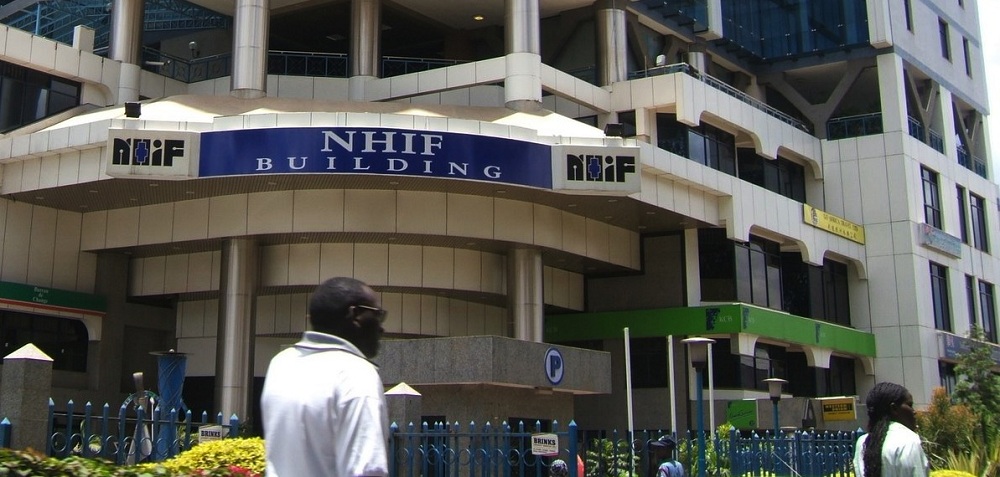
About 80 health facilities countrywide are under investigations for their involvement in possible National Hospital Insurance Fund (NHIF) claims fraud.
Already, in the last two years, seven facilities have been suspended from offering services by the national health insurer in connection to possible fraud. The majority of the likely fraud cases under investigation involve overstating of claims, manipulation of the documents of non-existing hospitals and pharmacies, or cover up and non- disclosure of medical facts at the proposal stage.
The social health insurer noted that healthcare fraud, waste and abuse directly contributes to the need for higher premiums for sustainability and reduces the amount of money available to improve quality of care for beneficiaries. This has also led to the shrinking of the available benefit package to members, thereby raising barriers to accessing health while distorting equity in the financing scheme.
“Fraud leads to the shrinking of the available benefit package to members, thereby raising barriers to accessing quality health and ultimately increasing the cost of healthcare,” said Mr Gilbert Osoro, Manager, Benefits and Contracting at NHIF.
Addressing a media briefing, Mr Osoro said that the NHIF management has taken note of the increase in the magnitude of the risk by re-engineering the claims process to enhance efficiency and effectiveness in payment processing for legitimate claimants.
He said to curb likely fraud, NHIF will invest money in new futuristic technology that allows for review, investigations and timely payments of the claims.
The system will replace the earlier approach referred to as pay-and-chase for recovery of payments which had loopholes for possible fraud and abuse.
Mr Osoro asked Health Care providers to work with NHIF in minimizing fraud by avoiding unnecessary services solely for the purpose of benefiting unwarranted admissions, unnecessary laboratory tests and radiological imaging.
They should also avoid cases of billing services that were never rendered, billing for brand name medication when generics were dispensed, falsifying claiming documentation by overstating of admission days, billing for a costlier service than the one actually performed, fabricating claims, padding claims with charges for procedures or services that did not take place and billing a patient more than the co-pay amount for services that were prepaid or paid in full by the benefit plan under the terms of a managed care contract.
NHIF has in the past raised the alarm over rising cases of increased medical fraud from both private and public health institutions. Some hospitals have been billing both patients and NHIF, while cases of impersonation and some hospitals launching claims with the intention to defraud the Fund using members’ cards without their consent.
“It is therefore the shared responsibility of the Fund and its stakeholders, NHIF staff as a whole, healthcare providers, including non-clinical support staff, government agencies, enrolled Beneficiaries and appropriately qualified staff designated to manage benefits and quality Assurance activities to take lead in fighting fraud wastage and abuse. NHIF thus calls on all stakeholder to expand and strengthen collective action, create new alliances, and search for innovative joint solutions to the shared challenges with implementation at a greater pace,” stated Mr Osoro.
More than half of the insurance fraud in Kenya is perpetrated in the medical and motor insurance sectors.
Read: MPs pour cold water on Uhuru’s Big Four Agenda
A report by advisory firm KPMG released recently estimates that 25% of health claims made in Kenya are fraudulent. In 2016, the sector paid out Ksh 1.9 billion in medical claims, meaning insurance firms may have lost up to Ksh 500 million to fraudsters.









This article concerning the aspects of medical billing was very informative. I was dealing with a website of medical laboratory billing services, We handle a website regarding this aspect in which we keep a track record of our content dating back to the previous year and make strategies to improve them. However, this article was much needed for our team and it will be something that I will be keen to review.
Thank you for sharing Helpful Content
It really is unsettling to read about 80 health facilities being investigated over NHIF fraud, especially when you think about how many patients rely on those services every day. The whole billing process is so complex that it’s easy to see how errors or intentional missteps could slip through, but that doesn’t make it any less frustrating. I’ve been in situations where keeping track of multiple records and invoices feels overwhelming, and I can only imagine the scale of what these facilities handle. That’s why having a simple way to organize and verify data matters so much. If you’re ever managing lists of facilities or claims, a bulk QR code generator from CSV could help you quickly encode and cross-check information without manual entry. It’s a small tool, but it might save someone a headache down the line.
It’s unsettling to read about 80 health facilities being investigated over NHIF fraud, especially when so many people depend on that cover for their medical bills. The article makes you wonder how billing systems can be so easily manipulated, and it reminds me how important it is to double-check every claim and record. I’ve spent time reviewing our own lab billing logs, and it’s a tedious but necessary habit. When I need a mental break from all that number-crunching, I sometimes pull up an afinador de guitarra online to reset my focus. It’s a small thing, but it helps me come back to the spreadsheets with a clearer head. Hopefully the investigation leads to real accountability and better safeguards for patients.
This is disheartening. Such fraud undermines public trust in healthcare. It reminds me of the strict standards journals like JAMA uphold. jama manuscript submissions